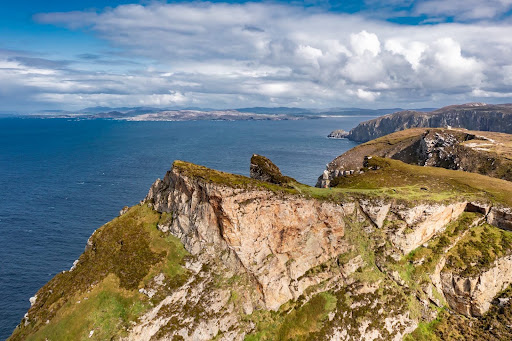
There’s a particular kind of quiet that settles over you on the Wild Atlantic Way — somewhere between a headwind on an exposed headland and the smell of turf smoke drifting from a cottage chimney. I’ve ridden plenty of coastlines, but nothing quite matches the feeling of tracing Ireland’s western edge on two wheels, with the Atlantic doing its best to remind you who’s really in charge out there.
The Wild Atlantic Way is the longest defined coastal touring route in the world, stretching for roughly 2,500km from Kinsale in County Cork all the way up to the Inishowen Peninsula in County Donegal. Cyclists have been quietly rerouting it for years — following the same spine of cliffs, bays, and peninsulas the road trippers use, but picking off the quiet lanes and coast roads that a car would just sail past. If you’re thinking about taking it on, here’s everything I’ve learned about riding it properly. If you’d rather stitch together your own path through Ireland’s quieter corners, my post on cycling destinations off the beaten path in Ireland is a good place to start too.
The Route at a Glance
The official route is broken into 14 signposted stages, running from Donegal in the north down through Sligo, Mayo, Galway, Clare, Limerick, Kerry, and Cork. You don’t have to ride every kilometre of it to get the full experience — most cyclists pick a stretch of a few weeks and let the rest wait for another trip — but if you’re going end to end, budget somewhere between two and four weeks depending on your daily distance and how often you want to stop and actually look at the view instead of just riding through it. If a route this long is new territory for you, it’s worth reading up on planning a longer cycling adventure before you commit to dates.
One tip that’ll save you some suffering: ride from south to north. The prevailing wind comes off the Atlantic from the southwest, and riding with it at your back rather than into your face makes an enormous difference over the length of this route. I learned this one the hard way on an early attempt, grinding into a headwind through Clare that took the joy clean out of an otherwise gorgeous day.
Donegal and Sligo: Wild Beginnings
If you start in the north, Inishowen is where it all kicks off — Ireland’s northernmost peninsula, and about as dramatic an introduction as you could ask for. The climb up Mamore Gap is short but properly steep, with gradients that’ll have you out of the saddle, and it rewards you with views back over Lough Swilly that make the burn in your legs feel entirely worth it. Malin Head, the very tip of the peninsula, has a raw, end-of-the-world quality that’s hard to describe until you’re standing there with the wind trying to take your bike from you.
Further south, the Slieve League cliffs are among the highest sea cliffs in Europe, and the road that skirts them is narrow, quiet, and utterly spectacular. Give yourself time here rather than rushing through — this is a stretch you’ll want to remember.
Mayo and Galway: Atlantic Drama
Achill Island, connected to the mainland by a bridge, is one of my favourite detours on the entire route. The Atlantic Drive loops around the island with barely any traffic to contend with, and Keem Bay at the end of it has the kind of turquoise water that looks faked in photos until you’re actually standing over it.
From there, the road winds down past Croagh Patrick and into Westport, a good spot to restock and rest your legs for a night, before Connemara opens up ahead of you — bog, rock, and mountain in every direction, with Killary Harbour cutting a fjord-like line between Mayo and Galway. This stretch has some of the most remote-feeling cycling on the whole route, and the roads are quiet enough that you’ll spend long stretches with nothing but sheep for company.
Clare and the Burren: A Different Kind of Beautiful
The Burren is unlike anywhere else on this route, or arguably anywhere else in Ireland. It’s a limestone landscape that looks almost lunar — bare grey rock stretching to the horizon, with wildflowers pushing up through cracks in the stone in a way that feels like it shouldn’t work but somehow does. The cycling here is rolling rather than mountainous, which makes for a welcome change of rhythm if you’ve just come down through Connemara.
Keep the Cliffs of Moher on your list, but be prepared for crowds if you arrive in the middle of the day — an early start is worth it here, both for the light and for having the place closer to yourself.
Kerry: Dingle and the Ring
Kerry is where a lot of cyclists say the Wild Atlantic Way earns its reputation, and I won’t argue with them. The Dingle Peninsula packs an extraordinary amount of coastline into a small area, with the Conor Pass offering one of the highest mountain passes in Ireland and views out over Brandon Bay that are worth every metre of climbing.
The Ring of Kerry gets the tour buses, so where you can, look for the quieter inland alternative through the Black Valley and the Gap of Dunloe — a narrow mountain pass that’s effectively closed to regular traffic, which makes it one of the genuine pleasures of cycling in this part of the country. It’s a proper climb, but it’s the kind of road you’ll be telling people about years later.
Cork: Beara, Sheep’s Head, and the Finish
The final stretch through West Cork takes in the Beara Peninsula and the Sheep’s Head Peninsula, both quieter and less visited than their Kerry neighbours but every bit as scenic. Healy Pass, on the Beara, is a proper test of your climbing legs, with switchbacks that unfold Bantry Bay beneath you the higher you get.
From there it’s a rolling run down through Mizen Head — the most southerly point on the Irish mainland — and on into Kinsale, a colourful harbour town that makes for a fitting place to toast the end of the ride with something well earned.
Planning Your Ride
May through September gives you the best odds of dry, bright weather, though I’d say pack for rain regardless of when you go — the changeable weather is part of the deal out here, and a good waterproof jacket will do more for your mood than almost any other piece of kit. If you’re not sure what else to pack, my gear checklist for long-distance cycling covers everything I bring on trips like this. The climbing adds up more than the coastal setting suggests; you’re looking at tens of thousands of metres of elevation gain if you ride the full route, so don’t let the sea-level image fool you into thinking this is a flat ride.
Accommodation ranges from hostels and campsites to proper guesthouses, and booking ahead in July and August will save you a lot of stress, particularly around the more popular stretches in Kerry and Clare. Outside of peak season, you can be a bit more spontaneous about where you end up each night, which has its own charm.
A route this long also means a lot of hours in the saddle on unfamiliar, narrow roads, so it’s worth a read of my cycling safety tips before you set off, and giving your bike a proper once-over using my essential maintenance checklist — the last thing you want is a preventable mechanical on a cliff road with no phone signal.
Whatever stretch of it you choose to ride, the Wild Atlantic Way has a way of getting under your skin. It’s not always comfortable — the wind, the rain, the climbs that seem to appear out of nowhere on roads that look flat on the map — but it’s honest cycling, in some of the most beautiful country you’ll ever ride through, and it’s easy to see why so many riders come back talking about the mental health benefits of cycling as much as the scenery. Pack your rain gear, point your front wheel south to north, and go and see it for yourself.
Related reading:
- Cycling Destinations Off the Beaten Path In Ireland
- The Ultimate Gear Checklist for Long-Distance Cycling
- Cycling Safety Tips – Staying Safe on Every Ride
- 10 Essential Maintenance Tips Every Cyclist Should Know
- Cycling Across Continents – Planning Epic Adventures
- The Mental Health Benefits of Cycling – More Than Just Exercise