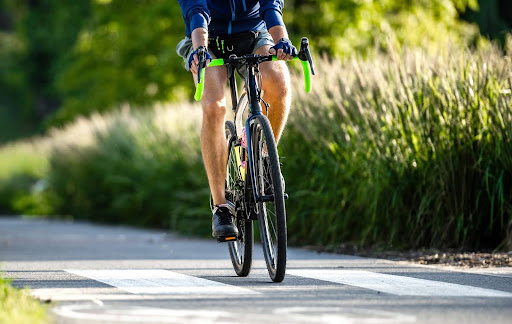
For my first couple of years of proper riding, I treated every hill like an argument I had to win. Big gear, slow legs, knees screaming, and a firm belief that grinding harder was the same thing as getting fitter. It wasn’t. It was just a quick way to arrive at the top with nothing left in the tank, and a dull ache around the kneecap that I put down to getting older.
What changed things wasn’t a new bike or a new training plan. It was learning to pay attention to how fast my legs were turning, and how smoothly. If you’ve ever wondered why some riders seem to float along while you’re working flat out, this is a big part of the answer.
What Cadence Actually Is
Cadence is simply how many times you turn the pedals per minute, measured in revolutions per minute (rpm). Most cycling computers and smart trainers will show it, and plenty of basic ones do too, with a small sensor on the crank. It sounds like a dry number, but it’s one of the few levers you have for changing how a ride feels without changing how fast you’re going. Two riders can travel at exactly the same speed, one spinning an easy gear quickly and the other pushing a heavy gear slowly, and feel completely different at the end of it.
The trade-off is worth understanding. A lower cadence means more force through each pedal stroke, which loads your leg muscles harder. A higher cadence means less force per stroke but more strokes, which shifts the effort towards your heart and lungs and demands a bit more coordination. Neither is free. You’re just choosing which kind of tired you’d rather be.
So What’s the “Right” Cadence?
Here’s the honest answer: there isn’t one single number. Many trained riders settle somewhere in the 80 to 95 rpm range on the flat, and a little lower, perhaps five to ten rpm, on sustained climbs. But the research is a lot more relaxed about this than the cycling magazines tend to be. In studies of experienced cyclists, the cadence riders chose for themselves turned out to be about as efficient as anything a lab could prescribe, and forcing people to spin much faster or much slower generally made them slower over a time trial, not faster.
If you’re newer to riding, that’s genuinely good news. You don’t need to chase some magic 100 rpm because a pro on the telly does it. What’s far more common among newer riders is the opposite problem: pushing too big a gear at a cadence that’s well below what feels natural, which is hard on the knees and burns your legs out early.
Finding Your Own Sweet Spot
The simplest way to find your range is to test it rather than guess. Pick a flat stretch of road or a session on a turbo trainer, ride at a steady, moderate effort at your natural cadence for around eight minutes, then repeat the same effort at roughly five rpm lower and five rpm higher, with an easy spin in between. Keep your gearing and position consistent and pay attention to how it feels: breathing, comfort, smoothness, and how much control you have. Try it again on another day before drawing any conclusions, because one session can easily be skewed by a bad night’s sleep or a tailwind.
The point isn’t to find a single perfect number. It’s to learn the range where you feel strong and in control, so you can recognise when you’ve drifted out of it. On a long day, that awareness makes a huge difference, and it’s one of the things I’d flag for anyone planning something like the Wild Atlantic Way, where a steady, sustainable cadence over thousands of metres of climbing matters far more than any single heroic effort.
Smooth Pedalling Technique
Cadence tells you how fast. Technique tells you how well. A few things are worth getting right.
Think in circles, not stamps. The aim is a smooth, continuous pedal stroke rather than a series of hard pushes on the downstroke with a dead patch at the bottom. Keep your ankles reasonably loose, so power carries through the bottom of the stroke rather than stalling there. One cue that works for plenty of riders is imagining you’re scraping something off the bottom of your shoe as your foot comes through.
Don’t yank up on the upstroke. This one surprises people. It’s tempting to think you should actively pull the pedal up to make use of a clipped-in shoe, but trying to do so tends to fight against the other leg, which is already pushing down. Aim to unweight the rising foot, lifting it just enough to get out of the way, and let the other leg do the driving. Whether you’re on clipless or flat pedals, smooth and balanced beats forceful and lopsided.
Get your saddle height right. A saddle that’s too low leaves your knees bent through the bottom of the stroke and cramps your breathing, while one that’s too high makes you rock side to side and lean on your calves to finish each revolution. If you’re not sure, a bike fit is one of the best investments you can make, and pedalling efficiency guides like this one break down exactly what to look for. Persistent knee pain is a reason to get a proper fit or speak to a professional, rather than something to ride through.
Keep your upper body quiet. A stable core and relaxed shoulders and hands mean more of your energy goes into the pedals and less into wobbling around on top of the bike. If you notice yourself bouncing in the saddle at higher cadences, that’s usually a sign your pedalling isn’t as smooth as it could be yet, not a sign to slow down permanently.
Simple Drills to Improve Your Pedal Stroke
You don’t need a coach or a lab to build a smoother stroke. A few easy drills will do it.
Spin-ups are a good place to start: on a flat road or a turbo trainer, gradually increase your cadence by a few rpm every minute until you start to bounce, then ease back slightly until you’re smooth again and hold that for a few minutes. The idea is to widen the range you can pedal smoothly, not to make that high cadence your everyday default.
Single-leg drills, where you unclip one foot and pedal with the other for short stretches, are brilliant for exposing dead spots in your stroke. They feel awkward at first, and that’s exactly the point. Do them on a turbo trainer rather than the open road, keep each effort short, switch legs before either gets tired, and aim for a smooth, even circle.
Finally, just vary your cadence on normal rides. Spend a few minutes spinning an easier gear, a few minutes pushing a slightly bigger one, and keep your technique tidy throughout.
Gearing Is Part of the Answer
It’s worth saying that technique can only do so much if your gears don’t let you ride at a sensible cadence in the first place. If you find yourself grinding at a painfully slow cadence on every climb, you may simply be running gearing that’s too tall for the terrain, rather than being weak. That matters a lot on hilly or loaded rides, and it’s one of the things worth thinking about alongside the rest of your long-distance gear before a big trip. The same goes for off-road: if you’re just starting out on the trails, my beginner’s guide to mountain biking covers why a lighter gear and a steady rhythm beat mashing the pedals up every climb.
Riding Smarter
The best thing about working on cadence and technique is that it doesn’t cost anything, and it pays off on every single ride. A smoother stroke saves your legs and your knees, a sensible cadence spreads the effort across your whole body instead of burning out one set of muscles, and a bit of awareness turns hard climbs into something more manageable. Keep your drivetrain in good shape too, because a gritty, neglected chain works against all of this, and my maintenance tips are a good place to start.
So next time a hill appears, resist the urge to grind it out. Drop a gear, find your rhythm, keep your pedal stroke smooth, and let your legs do the work they were built for. You’ll get there faster, and you’ll still have something left when you do.
Related reading:
- Clipless vs Flat Pedals: Which Is Right for Your Riding Style
- 10 Essential Maintenance Tips Every Cyclist Should Know
- The Ultimate Gear Checklist for Long-Distance Cycling
- Beginner’s Guide to Mountain Biking – Getting Started on the Trails
- The Wild Atlantic Way by Bike: An Irish Coastal Route Guide
- Cycling Across Continents – Planning Epic Adventures