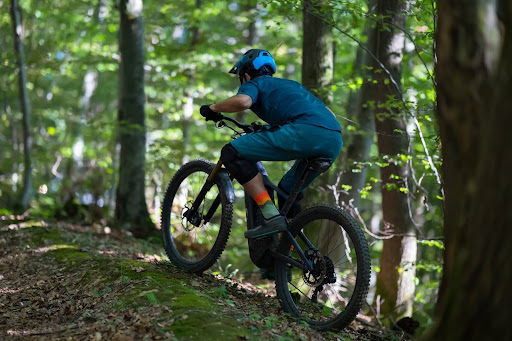
There’s a moment on a long, rough descent that most mountain bikers will recognise. The first few minutes feel great. Then your forearms start to burn, your grip loosens, your core stops holding you quite where you want to be, and suddenly the bike is steering you rather than the other way round. It’s rarely a fitness problem in the sense of lungs and legs. It’s a strength problem, and no amount of extra time in the saddle quite fixes it.
That’s where time off the bike earns its place. Done sensibly, a couple of short strength sessions a week can make you more stable, more powerful, and a lot more comfortable on the kind of terrain that punishes weak links. Here’s how I’d approach it.
Why Mountain Biking Asks So Much of Your Body
Road riding is mostly a repetitive leg-and-lung job. Mountain biking is a full-body sport in disguise. You’re pedalling hard up a climb, then hanging off the back of the bike, absorbing hits through your arms, bracing with your core, and shifting your weight from one side to the other through corners, often all within the space of a couple of minutes. The muscles doing that work, your glutes, hamstrings, core, shoulders, and grip, don’t get much of a workout from pedalling alone.
Strength work covers that gap. If you’re still getting to grips with the basics, my beginner’s guide to mountain biking is a good place to start, and this post is the natural next step once you want to ride harder and for longer without feeling battered afterwards.
What the Research Actually Says
It’s worth being honest about what strength training can and can’t do for a cyclist. A 2025 systematic review and meta-analysis of heavy strength training in endurance cyclists found that it improved cycling efficiency, anaerobic power, and overall performance compared with riding alone. It didn’t significantly change VO2max or some other endurance markers, and the overall certainty of the evidence was rated as low, so nobody can yet say precisely how much to do, or exactly how.
That’s an important point, and it’s the reason I’d avoid anyone promising that a gym programme will transform you overnight. What it does suggest is that strength work is a worthwhile complement to riding rather than a replacement for it. And because most of the research is on road and endurance cyclists, how much of it carries over to the specific demands of the trail is a fair question. Roadman Cycling’s guide to strength training is a good plain-English summary if you want to dig into the detail.
The Movements Worth Doing
There’s no single perfect exercise list, but the movements that tend to matter most for mountain bikers fall into a few simple patterns: single-leg work, hip hinges, pushing and pulling, and trunk stability.
Walking lunges with a twist. These work the glutes and quads in a way that closely mirrors the pedal stroke, and the rotation adds a bit of trunk control on top. BikeMag’s home exercise guide suggests 25 to 30 reps as a starting point.
Single-leg deadlifts. Glutes and hamstrings do most of the work on climbs and sprints, and single-leg deadlifts hit them hard while also challenging balance and stabilising the knees. Start light, with bodyweight or a small dumbbell, and focus on a flat back and a controlled movement.
Lateral jumps or skater hops. Side-to-side movements are useful because so much of mountain biking is about shifting weight from one side of the bike to the other, through corners and over uneven ground.
Plank variations. A strong, stable core helps you stay centred on the bike, which matters on long descents and technical climbs alike. Planks with a single-arm row, or side planks, are more demanding versions once the basic plank feels easy.
Push-ups on an unstable surface. Upper-body strength gets overlooked by a lot of riders, but your arms and shoulders absorb a surprising amount of punishment on rough trails. Push-ups with your hands on a ball or a wobble board add a balance challenge that helps when the front wheel gets knocked off line.
Something for your grip. Aching forearms are one of the most common reasons riders ease off on descents. Farmer’s carries, dead hangs from a bar, and heavy rows all build grip strength, and they’re an easy addition to the end of a session.
How Often, and How Heavy?
For most riders, two short full-body sessions a week, on non-consecutive days, is a sensible place to start. That’s a practical starting point rather than a magic number. The studies in the meta-analysis used anywhere from one to three sessions a week, and no particular frequency stood out as clearly better than the others.
If you’re new to lifting, spend the first few weeks learning the movements at a comfortable weight, leaving plenty of reps in reserve, before you start making them properly hard. “Heavy” in the research generally means something like 80 percent of the most you could lift once, but you don’t need to be anywhere near that to start getting something out of it. If you have an existing injury, or you’re unsure about technique, it’s worth speaking to a qualified coach or your GP before you start.
Scheduling It Around Your Riding
The golden rule is to protect your key rides. Avoid heavy leg sessions just before a hard interval session, a long day out, or a race, because tired legs make for poor riding and a higher risk of a silly mistake on the trail. Many riders find it easiest to lift on easier riding days, or on a rest day, and keep their hardest rides fresh.
Winter is the ideal time to build the foundation. When the trails are muddy and the evenings are dark, a few gym sessions a week are an easy habit to slot in, and you’ll come into spring stronger and better prepared. As your riding load builds up in summer, cut back on the volume of your strength work rather than dropping it altogether, keeping a short maintenance session in place so you hold on to what you’ve built.
Keep an eye on how you’re recovering too. If you’re sore for days afterwards, or your rides are consistently suffering, that’s a sign to reduce the volume or move the session. And if you’ve got a long trip coming up, my long-distance gear checklist and safety tips are worth reading alongside your training plan.
Don’t Forget Your Technique on the Bike
Strength is only useful if you can put it to work, and that comes down to technique. A stronger core and glutes will help you hold a good body position, but so will smooth pedalling, which I covered in cadence and pedalling technique, and the right pedal setup, which depends a lot on your riding style. If you’re still deciding between the two, my guide to clipless vs flat pedals breaks it down properly.
A Stronger Rider Is a Happier One
There’s a bonus to all of this that has nothing to do with performance. Strength training is good for you in general, and as someone who’s ridden through plenty of tough days, I can say the confidence that comes from feeling strong is a real thing. It’s part of the same story as the mental health benefits of cycling: the more capable you feel, the more you enjoy being out there.
You don’t need a fancy gym or a complicated plan. Two short sessions a week, a handful of the movements above, and a bit of consistency will get you most of the way. Start small, build steadily, and the next time you’re hanging on at the bottom of a long, rough descent, you might find there’s a bit more left in the tank than you expected.
Related reading:
- Beginner’s Guide to Mountain Biking – Getting Started on the Trails
- Cadence and Pedalling Technique – Riding Smarter, Not Harder
- Clipless vs Flat Pedals – Which Is Right for Your Riding Style
- The Mental Health Benefits of Cycling – More Than Just Exercise
- Cycling Safety Tips – Staying Safe on Every Ride
- 10 Essential Maintenance Tips Every Cyclist Should Know